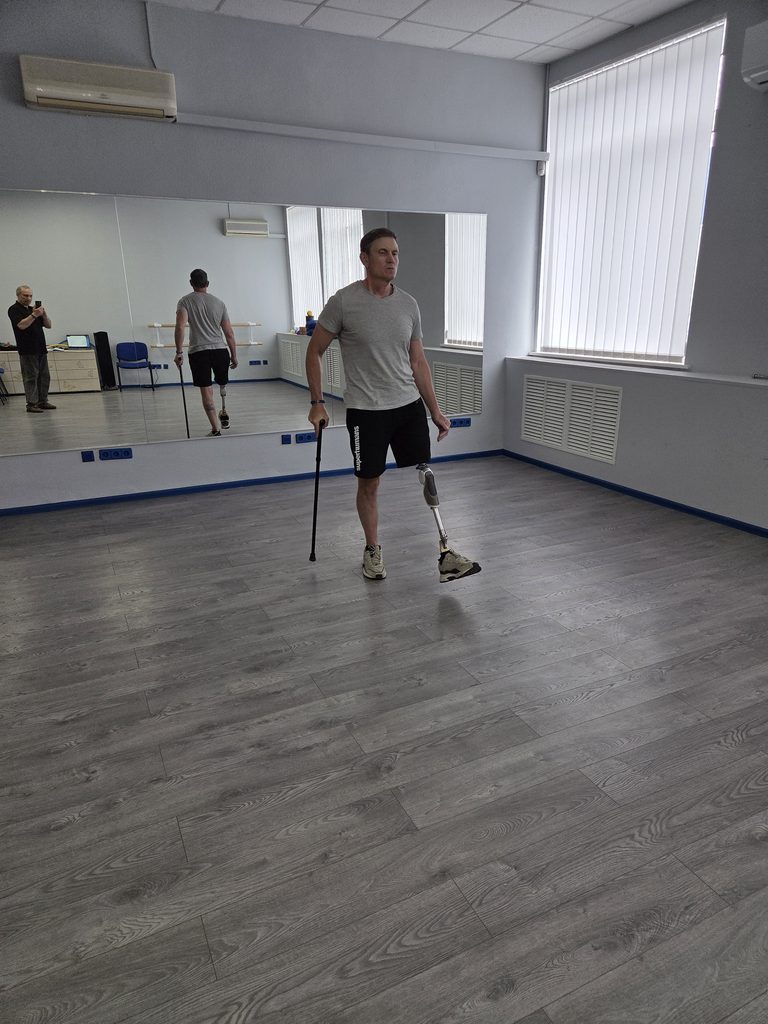
I recently had a wonderful opportunity to apply my expertise in dance rehabilitation to a serviceman who had residual vision and a prosthesis on his left leg.
In May 2026, a serviceman named Ihor—who had a leg prosthesis—arrived at our rehabilitation center. Nearly a year and a half had passed since he sustained his injuries; he had almost no vision in his right eye, and about 20 percent vision in his left. Furthermore, as a result of blast injuries, his hearing was impaired—by 60 percent in his right ear and 40 percent in his left. Ihor’s cognitive faculties remained fully intact, and he was highly motivated to improve his safety and mobility when moving through space.
When Ihor came to my sessions and I observed how he moved, my first question to myself was: “Is there anything I can do to help him?” My answer was: “Yes.” I always ask myself this question whenever a new patient arrives.
Observing how Ihor navigated his environment, I noted the following:
1. When walking, Ihor moved his prosthetic leg in a manner similar to someone recovering from a stroke—swinging the leg out to the side rather than moving it directly forward in the direction of travel.
2. Ihor used a cane for safe mobility; in my opinion, it was 5–7 cm too short for him, as it was evident that he leaned his spine toward the cane while walking.
3. When Ihor stepped onto his prosthesis, he used it as a small point of support—much like an additional cane.
4. At the beginning of our sessions, Ihor did not believe at all that he could maintain his balance while standing on a single prosthesis.
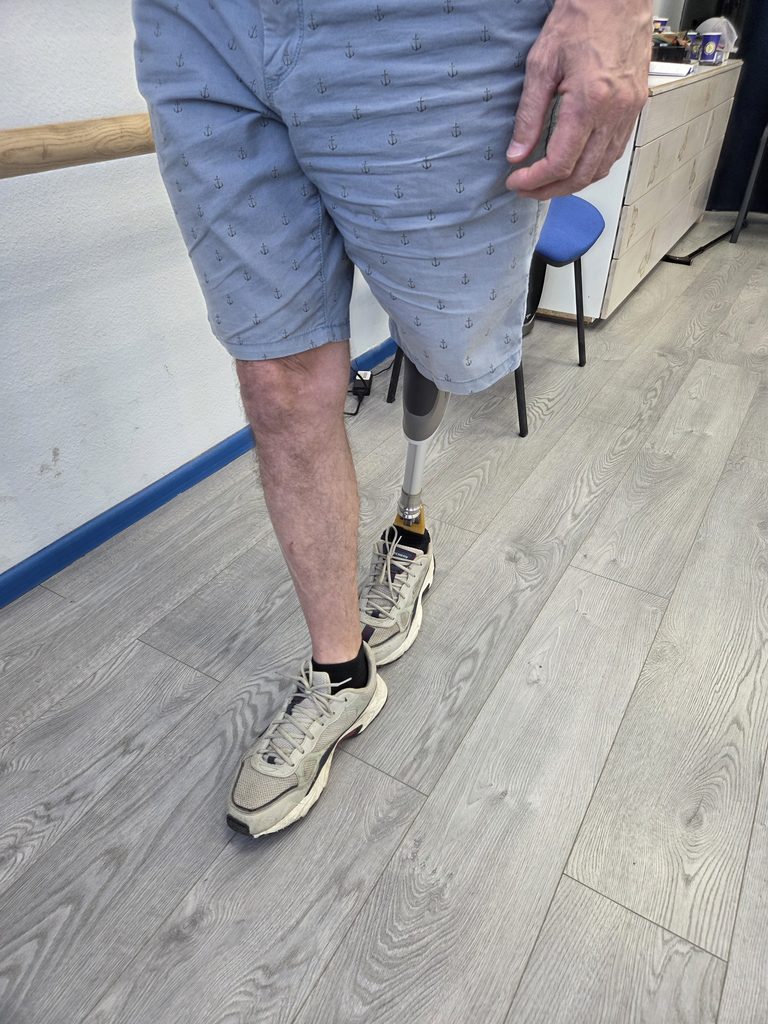
From the very start, I incorporated Moshe Feldenkrais’s concepts of “Awareness Through Movement.” The first exercise took place at a ballet barre: holding onto the barre with his feet together, Ihor shifted his body weight across his feet, noting exactly where his weight was distributed—whether on his heels, the midfoot, or his toes.
The second exercise involved a foot position derived from a modified Romberg test, where the heel of one foot is placed in front of the toes of the other. Ihor shifted his body weight from the heel of the rear foot toward the toes of the front foot, continuously tracking his center of gravity—moving from the heel, midfoot, and toes of the rear foot, through the transition of weight from the rear toes to the heel of the front foot, and finally across the midfoot to the toes of the front foot. He experienced the same sensations when moving his body in the opposite direction. While Ihor was performing these two exercises, I encouraged him to start perceiving the prosthetic foot as a normal foot, rather than just a small point of support. Afterward, Ihor completed two more exercises. One resembled the sobriety test administered to drivers suspected of alcohol consumption—though Ihor positioned his feet as in a modified Romberg test. He walked forward for 8–9 meters and then walked backward.
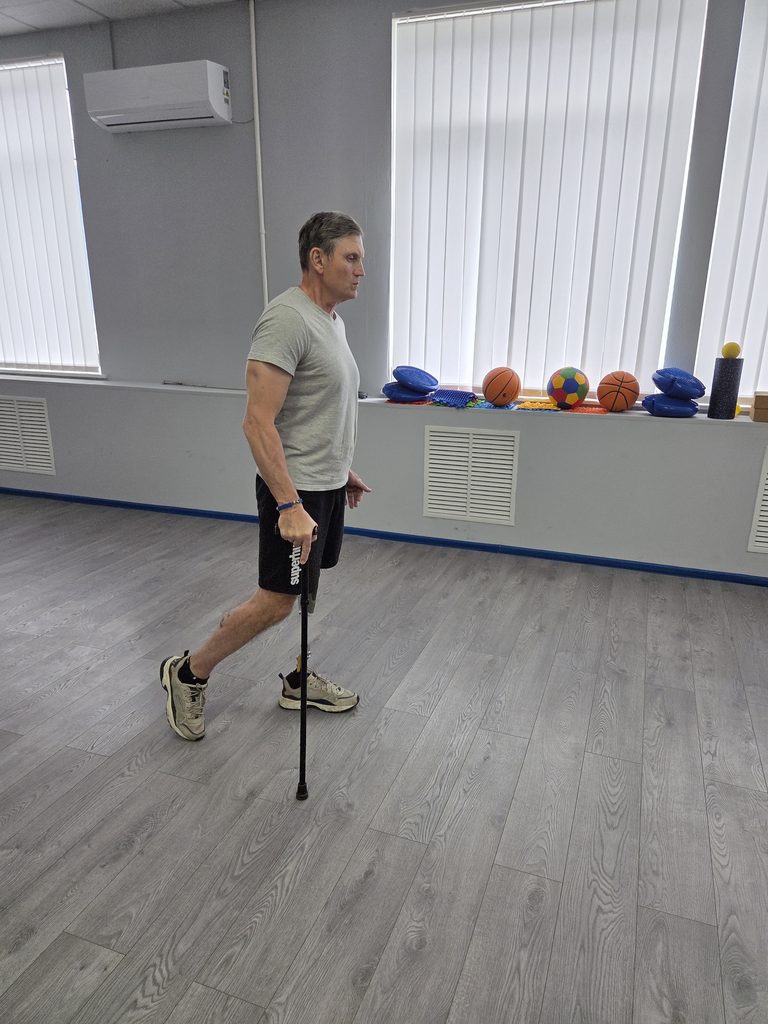
I called the second exercise “3 Seconds.” This is because blind individuals sometimes catch their foot on an obstacle; in such moments, they may need to balance on one leg for three seconds or longer to make the right decision. Essentially, for their own safety, blind individuals need a well-functioning vestibular system and the ability to stand on one leg for at least five seconds. Consequently, all the blind individuals I work with perform this exercise. Ihor would take a small step forward and hold his balance on one leg for three seconds, then step onto the other leg and hold it for another three seconds.
By the fifth or sixth session, his conviction that he was incapable of maintaining balance on a single prosthesis began to gradually fade. Unfortunately, his rehabilitation period at our center was quite short; nevertheless, Ihor managed to reach a point where he could stand on his prosthetic leg for at least a second or two. Once Ihor developed a much better awareness of his own body, his muscles, and the sequence in which they function, I asked him to stop gripping his cane tightly. Instead, I suggested he hold it only with his fingertips—effectively “extending” the cane’s length. He walked down a long corridor several times, alternating his grip between the standard hold and this “virtual” extension—where he barely touched the cane with his fingers. He realized that the cane was actually too short for him, as he could feel his spine leaning forward.
After a few additional exercises, Ihor began walking much more upright; he no longer resembled someone recovering from a stroke. He was even able to dance a slow waltz with great skill and confidence.
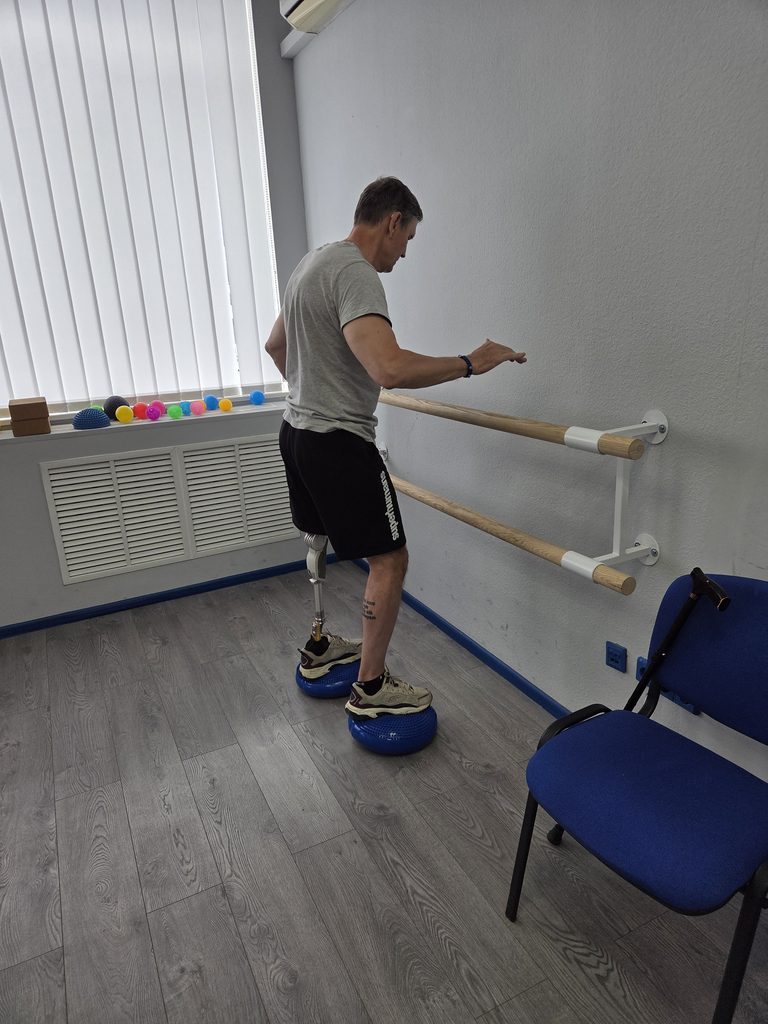
At the end of his rehabilitation period at our center, he confided in me that he felt much more confident moving around. His coordination had improved, and incidents of losing his balance or falling had decreased significantly.
Working with someone who has residual vision and a prosthetic leg was a wonderful, engaging, and highly rewarding experience—and it is deeply gratifying to know that my efforts truly made a difference.
Glory to Ukraine!